Ever wish your students were more motivated? If you’re like most of us, you have tried an array of rewards and punishments to motivate kids. There’s only one problem: it doesn’t work. At least it doesn't work well enough. People (yes, even students) aren’t motivated from the outside so rewards and punishments only work to a point. We are internally motivated. That’s why it's essential to engage and inspire students to be motivated to succeed in school (and life.)

If you’re ready to move beyond the reward/punishment model and embrace a whole new way to understand motivation, I encourage you to come back regularly. It’s time to challenge the status quo and create schools and classrooms based on what really motivates behavior.


Sunday, February 24, 2013

“How Do I Motivate My Son To Join Boy Scouts?” (Where Our Questions Lead)


I frequently say that we live in an “external control psychology” world and that we can’t escape from the incessant reward/punishment mindset. Sometimes I think I’m engaging in hyperbole. Then I have moments like the following:

I had just finished a hike in Scottsdale, Arizona and was at the top of Bell Pass in the McDowell Mountains. I was alone. It was peaceful. A few minutes later, two young women made it to the top (with considerably less huffing and puffing than me, I must admit) and were engaged in an animated conversation. “How can I motivate my son to join Boy Scouts?” one asked her friend.

As they chatted about the various rewards she could offer him to get him to join the Boy Scouts, I held my tongue, simultaneously trying to block out everything they said while wanting to soak in every word. It appeared as if these were good young mothers who only wanted the best for their kids. The “problem” from my perspective sprung from that very first question: “How do I motivate my son…???”

Like most parents, they began from the position that motivation is external, something you “do” to another. But motivation is internal, fueled by the five basic needs woven into our genes, including the need for freedom/autonomy. Precisely because of our drive to be self-governing, efforts to control us are often poorly received - even well intentioned attempts by loving parents to “motivate” us to do something they think will add quality to our lives.

Instead of trying to motivate a child to do something - a form of external control, even if it’s benign control – why not approach things from the perspective of internal motivation? Children are already motivated. Why would a child want to engage in the activity? How might it be need-satisfying? Why would a child be motivated to do this? How does it relate to her/his needs and quality world?

Children often lack the knowledge to understand why joining Scouts (or engaging in any other activity) would enhance their lives. But they don’t need you to “motivate” them. Instead, provide them with additional knowledge, add to their knowledge filter, and give them the opportunity to decide for themselves if Scouting (or any other activity) would be an enjoyable, need-satisfying experience.

Our behavior as parents emanates from the questions we ask ourselves. “How can I motivate my son to join Boy Scouts?” necessarily takes us down the external control pathway that invites conflict. “What information can I share with my son to help him appreciate that joining Boy Scouts would be a need-satisfying experience for him?” brings us down an entirely different road, one that respects the fact that motivation is internal and that everyone –even young children – are driven in part by a need to be autonomous. 
***
As always, if you enjoyed this and found it useful, please send the link to your friends. Thanks.


Bob Sullo
PO Box 1336
Sandwich, MA 02563

For information about books by Bob Sullo and to schedule a keynote, workshop, or series for your school, agency, or parent group visit www.internalmotivation.net

Monday, February 18, 2013

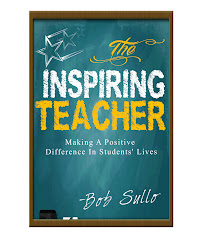
No Kindle? No Problem? You Can Still Download The Inspiring Teacher


Since the publication last week of The Inspiring Teacher: Making A Positive Difference In Students’ Lives, I have had a number of people ask me if there is any way for them to get this newly revised edition if they don’t have a Kindle. The answer is, “Yes!”

If you have an iPad, you can download a Kindle app for free. It’s exactly the same as having a Kindle on your iPad. (Aside: I also have a Nook on my iPad. It’s like having three e-readers in one.)

There are other options as well. You can get a free Kindle app for a Smartphone, Computer (both Mac and Windows), or Tablet. For more information and easy step-by step-directions on how to read a Kindle book even if you don’t have a Kindle, click here.

***
As always, if you enjoyed this and found it useful, please send the link to your friends. Thanks.

Bob Sullo
PO Box 1336
Sandwich, MA 02563
bob@internalmotivation.net
www.internalmotivation.net
www.twitter.com/bobsullo

For information about books by Bob Sullo and to schedule a keynote, workshop, or series for your school, agency, or parent group visit www.internalmotivation.net

Tuesday, February 12, 2013

New Book! The Inspiring Teacher: Making A Positive Difference In Students’ Lives


I’ve had a number of people asking where I’ve been and if I’m OK since I haven’t posted anything in quite some time. My younger daughter, who lives in Australia, was home for the holidays so I spent lots of time with family until after the New Year.

I have also been immersed in a full-blown revision of my book The Inspiring Teacher: Making A Positive Difference In Students’ Lives. I am very excited to announce that the book has just been published by Funderstanding and is now available from Amazon.

My goal was simple: make this book available as an e-book and keep the price so low that schools can easily afford to get copies for every staff member and use it as part of their PD initiative. I know that budgets are shrinking and that schools must carefully consider every dollar spent. The Inspiring Teacher has a “Reflect, Personalize, and Implement” section at the end of each chapter, questions that make it easy to facilitate a book talk and engage every staff member in substantive conversations about how to make schools better for kids and adults.

I’m hope you’ll take advantage of the introductory low price and tell every educator and parent you know about The Inspiring Teacher.

Here’s the opening from the book to give you a sense of what it’s all about:

Let’s start with an obvious question: “Who should read The Inspiring Teacher?” Fair enough question. In putting together this newly revised edition, I had three specific groups in mind.

The Inspiring Teacher is for every teacher and teacher in training who wants more than just a job. It is for those who want to create rich, meaningful professional identities. It is for those who want to positively impact the lives of their students. It is for those who are determined to make a difference. The Inspiring Teacher is also for every parent who wants their kids to internalize important values and behave responsibility even when no one is watching and there is no promise of a “Student of the Month” award or a “Good Boy/Good Girl” shouted in their direction.

If you’re in at least one of these groups, The Inspiring Teacher is for you.


I’m seriously trying to challenge the status quo.

As always, if you enjoyed this and found it useful, please send the link to your friends. Thanks.

Bob Sullo
PO Box 1336
Sandwich, MA 02563

For information about books by Bob Sullo and to schedule a keynote, workshop, or series for your school, agency, or parent group visit www.internalmotivation.net

Sunday, December 2, 2012

"I Know We've Never Met, But I Think You're Fat. No Offense."


What does the following have to do with education? Everything from this episode can be applied to the classroom. Just as Jennifer Livingston knows she is overweight, most failing students are aware of their struggles. It doesn't help to criticize them, even if you believe “it's for their own good.” When you have something you think is important to share with your students -like the curriculum you are trying to deliver- remember that your efforts will be most effective when you create a positive relationship. Otherwise, much of what you say will fall on deaf ears. So here's it is....

A story about an overweight news reporter caught my attention. A viewer sent news anchor Jennifer Livingston an email berating her for her weight and suggesting she was a poor role model, particulalarly for young female viewers. In a moment that gained national attention, Livingston addressed the email on air, appearing on national TV shows like The Today Show and Good Morning America on October 3. She characterized the email as "bullying."

I'm not comfortable with that label. It might have been ignorant. It might have been hurtful. But it minimizes the horrendous problem of bullying when this reporter puts herself in the same category as an child victimized by a classmate. Youngsters are often defenseless against the slings and arrows of their peers. They lack experience, wisdom, self-esteem, and strength. Livingston is skilled, competent, and like most reporters, has received her share of ignorant emails. I appreciate her outrage, but there’s a difference between ignorance and bullying.

It doesn't matter whether the email writer’s intent was to be a hurtful, ugly bully or if he was genuinely concerned about Livingston’s health and believed in her ability to influence others. His email drew a strong rebuke from the anchor who stated, “The truth is, I’m overweight. You could call me fat. And, yes, even obese on a doctor’s chart.... Do you think I don’t know that?...You don't know me. You are not a friend of mine. You are not a part of my family.” If the intent of the email was to hurt, it was reprehensible and inexcusable. If the intent was to be helpful, it wins the award for "worst attempt to help a person you've never met."

I had never heard of Jennifer Livingston until the story broke. My guess is that she would rather weigh less. While the email writer talks about “choices” the reporter has made, I've never met a person struggling with weight who identifies their situation as a “choice.” I teach choice theory but would never say a person “chooses” to be fat. That's as cruel and ill-informed as suggesting there are students who “choose to fail” or people who choose to be economically disadvantaged. We are responsible for our behaviors and their consequences, but don't confuse that with conscious choice. Many of our behaviors, including some that impact weight, health, academic standing, and personal relationships are made without conscious awareness.

Let's give the emailer the benefit of the doubt and imagine his intent was positive. He sees a television news anchor he perceives to be influential and a role model. He believes her weight is a detriment to her health. He wants to help. The firestorm his email has created elegantly emphasizes the importance of relationships, especially when you want to provide information that might be perceived as painful. If the emailer seriously thought that he could write what he wrote to a person he never met and expect it would be read as a helpful expression of love and concern, well, suffice it to say he doesn't understand human behavior very well.

Because all of us are doing the best we can to satisfy our needs, we naturally resist information that might be defined as critical. If I don't know you, if we have no relationship, it's easy to dismiss your comments - even if they are right! The only way that I will take in and utilize painful information is when our relationship is strong enough that your love and concern trumps the painful content of your message. It goes back to the phrase, “They need to know that you care before they care what you know.”

***

As always, if you enjoyed this and found it useful, please send the link to your friends. Thanks.

Bob Sullo
PO Box 1336
Sandwich, MA 02563
For information about books by Bob Sullo and to schedule a keynote, workshop, or series for your school, agency, or parent group visit www.internalmotivation.net


Sunday, November 25, 2012

If A Child Doesn't Know How: The Role Of An Educator


“If a child doesn’t know how to read, we teach.”

“If a child doesn’t know how to swim, we teach.”

“If a child doesn’t know how to multiply, we teach.”

“If a child doesn’t know how to drive, we teach.”

“If a child doesn’t know how to behave, we... teach? …punish?”

Why can’t we finish the last sentence as automatically as
we do the others?

Tom Herner, 1998.

This quotation was posted my friend and colleague Sylvia Habel, President of The William Glasser Institute, Australia. She got it from one of her master’s students. The author, Tom Herner, is the former president of the National Association of State Directors of Special Education (NASDE).

I decided to share it because it so eloquently captures the primary role of an educator: to teach. Whether we’re talking about reading, swimming, multiplying, driving a car, or yes….behaving appropriately, our role is to teach.

Thanks to Tom Herner for these words, and to Slyvia and her student for bringing this to my attention. 
***

As always, if you enjoyed this and found it useful, please send the link to your friends. Thanks.

Bob Sullo
PO Box 1336
Sandwich, MA 02563

For information about books by Bob Sullo and to schedule a keynote, workshop, or series for your school, agency, or parent group visit www.internalmotivation.net

Saturday, November 17, 2012

"Anyone Can Be A Teacher:" A Salute to American Education Week


Today marks the end of “American Education Week.” It’s a time marked by celebration and outward expression of gratitude to those who help educate the next generation. Beneath all the good will and happy talk, however, there remains a belief that teaching isn’t all that big a deal. Let me give an example.

During a conversation with a friend concerning the recent strike by Chicago teachers, he remarked, “Anyone can be a teacher.” As someone who worked as a public school educator for 34 years and has dedicated my professional life to education, I found the comment offensive. (Adide to all my choice theory friends: I know my friend’s comment didn’t make me angry. I chose to be angry. It’s a choice I don’t regret. Sometimes anger is a legitimate choice. Hence the term “righteous indignation.”)

Since then, I have given his comment a lot of thought: “Anyone can be a teacher.” It would be one thing if the comment were made by someone uneducated and insensitive. I could have written it off as an understandable byproduct of ignorance.  But the comment was made by a highly educated, thoughtful, articulate, save-the-planet, unabashed liberal. His stinging rebuke, offered matter-of-factly and without a hint of rancor, got me thinking. Could he be right? Can anyone be a teacher?  Let’s look at what the research says:

  • For the sake of this discussion, I’m assuming a teacher has at least a bachelor’s degree. In 2011, the percentage of people age 25 and over with a bachelor’s degree in the United States was 30.44.  For the math-challenged among you, that’s less than one-third. Hmmm. Maybe it’s a bit of a stretch to suggest “anyone can be a teacher,” a sentence that rolls easily off the tongues of so many. Seems like nearly 70% of the US population in 2011 lacked the qualifications for a job that apparently “anyone can do.”
  • According to the National Center for Education Statistics, 52% of teachers in 2007-2008 had a master’s degree or higher. By way of comparison, slightly less than 8% of US citizens had attained a master’s degree in 2011.
“Anyone can be a teacher.” Even though statistics show that statement to be false, it remains a fairly common perception. There are lots of reasons why. Among them is the fact that most people have been to school. In fact, in the USA in 2011, almost 88% had attained a high school diploma, something that apparently qualifies them as self-identified “experts.” While most people pause before second-guessing their doctor, lawyer, car mechanic, or lawn care specialist, many find it their civil duty to identify what ails education and how best to fix it. Call it “expertise by osmosis.” Or maybe “familiarity breeds contempt.”

“Anyone can be a teacher.” I started my educational career as an English teacher. I genuinely enjoy language. Verbs, voice, tone, and tense intrigue me. In thinking about the comment, “Anyone can be a teacher,” I decided it might be more accurate to suggest “anyone can become a teacher.” While it’s still an inaccurate statement, I can live with the notion that obtaining a certificate to teach may be within reach for many. They can become a teacher. By that, I mean they have can secure a job. But to be a teacher…..that’s whole different kettle of fish. I think of the many special educators who I have met over the years, artfully finding ways to help kids who learn differently make connections they couldn’t make in a traditional classroom. I think of those teachers who not only “tolerated” some of the unattractive behavior of adolescents, but positively connected with kids who “didn’t deserve it” during those turbulent years. I think of those who work – successfully – with kids whose parents are unable or unwilling to give them the support that every student deserves. While lots of people can become a teacher, it takes something special to be a teacher.

“Anyone can be a teacher.” Despite statistics that refute the idea that “anyone can be a teacher,” the perception persists. Railing against its inaccuracy does little to change it. The challenge for teachers everywhere is to convince the population at large that teaching is a profession worthy of respect rather than derision.

Teachers need to find a way to earn the respect of my educated, perceptive, reflective, thoughtful friend. Currently, he is comfortable saying, “Anyone can be a teacher,” even as he attempts to soften the blow with the rejoinder, “Some of my best friends are teachers and they are smarter than I’ll ever be.” Individual teachers may be – indeed, many are – respected, but the profession as a whole does not get nearly the same level of respect as other professions, some requiring considerably less education and skill to be effective.

The path to respect will not be easy. Teachers must act professionally and become their own best advocates. For as long as I have been involved in education, teachers have failed miserably in that area, in large part because they have tried to remain above the fray. They have naively clung to a romanticized notion that teachers are universally respected and anything that smacks of self-promotion or PR is somehow unseemly or beneath them. Well, those days are over. And to much of the public, teachers unions seem only interested in their members, not the kids. To sway public perception, unions have to be seen as “standing with students and parents.” 

As American Education Week draws to a close, I salute those teachers who inspire the best in their students. They are the real job creators we desperately need.

***

As always, if you enjoyed this and found it useful, please send the link to your friends. Thanks.

Bob Sullo
PO Box 1336
Sandwich, MA 02563
Monday, November 12, 2012

Bullying: Prevention vs. Intervention


“The best violence prevention program is to build a sense of community.”

There are a number of intervention strategies to deal with the ever-present and increasingly alarming problem of bullying. As I frequently state in my presentations, “intervention is never as effective as prevention.” Intervention is initiated after a problem has begun so you’re scrambling and trying to play catch-up. In the case of bullying, emotions often come into play and can drive the decisions we make. Decisions made under emotion distress are not always the best.

Prevention, on the other hand, is proactive. We don’t start out behind the 8-ball. There is nothing more effective in preventing school violence and bullying than building a sense of community. While there will still be disputes and skirmishes, they are less likely to evolve into full-fledged violence or bullying when a sense of community has been established.

Here are a few questions to help you build a supportive school community. I suggest discussing them with your colleagues in an effort to create effective action plans:

  • On a scale of 1-10, with 10 being the most positive, how would you rate your school climate?
  • Are you satisfied with the rating you have given? If so, what do you need to do to maintain your success? If you’re not satisfied, what can you do to create a more positive school climate?
  • What are the qualities/characteristics of a “sense of community” in a school? How will you know if your school has this “sense of community”?
  • What can you (and your colleagues) do to create a sense of community in your school?
  • Will a sense of community help minimize violence and bullying in your school? If so, is it worth your time and effort?

As always, if you enjoyed this and found it useful, please send the link to your friends. Thanks.

Bob Sullo
PO Box 1336
Sandwich, MA 02563

For information about books by Bob Sullo and to schedule a keynote, workshop, or series for your school, agency, or parent group visit www.internalmotivation.net