Ever wish your students were more motivated? If you’re like most of us, you have tried an array of rewards and punishments to motivate kids. There’s only one problem: it doesn’t work. At least it doesn't work well enough. People (yes, even students) aren’t motivated from the outside so rewards and punishments only work to a point. We are internally motivated. That’s why it's essential to engage and inspire students to be motivated to succeed in school (and life.)

If you’re ready to move beyond the reward/punishment model and embrace a whole new way to understand motivation, I encourage you to come back regularly. It’s time to challenge the status quo and create schools and classrooms based on what really motivates behavior.


Monday, May 20, 2013

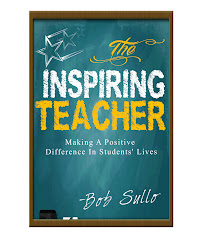
Walking the Talk: The Inspiring Teacher FREE from May 21-23!


The Inspiring Teacher is available for FREE from May 21-23. No catch. No gimmicks. Not a sample chapter. The complete book. For free. Not a loan. Yours to keep. For free.

After you read and download your free copy, I’d appreciate it if you’d write a review and post it on Amazon. It doesn’t need to be long. If it’s an honest, heartfelt endorsement, it will be much appreciated. Of course, you don’t need to write a review. You still get the book. No strings. No “if…then.” But reviews lead to more exposure and help get these ideas to a wider audience.

I wrote the e-book version of The Inspiring Teacher because I wanted to reach as wide an audience as possible. An electronic format made it easy to keep costs low. I asked my publisher, Funderstanding, to offer the book at a reasonable price. Of course, I want to get a huge royalty check, but my primary objective is to get the book into the hands of as many educators and parents as possible.

A few weeks ago, Eric Cohen, the “principal” of Funderstanding asked me if I was serious about getting the book out to as many as possible – even if it meant making less money.

“What are suggesting?” I asked.

“Why don’t we just give the book away,” he answered.

“You mean like an excerpt? Some kind of teaser?” I asked.

“No. I mean let’s just give it away,” Eric answered in his usual unflappable way, seemingly oblivious to the fact that what he was suggesting seemed extreme.

“ But…you’re a businessman. How can you turn a profit if we just give it away?”

“That’s right,” Eric said. “I am a businessman. You say you want to help lead the world with Choice Theory. So let’s make it easy for everyone to learn about it. In this case, ‘easy’ means ‘free.’ And, as for profit, I’m not worried. We’ve put together a quality product. These ideas make sense. We just need to get it out there. Giving it away will only increase awareness of Choice Theory and all the things you believe in and write about. Let’s just concentrate on how to get the book in front of as many people as we can. The profit will follow. You just have to trust me.”

Thanks to Eric, I have been given an opportunity to get what I want: reaching as wide an audience as possible and informing more educators and parents about Choice Theory and other compatible concepts designed to make school a more satisfying experience for kids and adults.

I continually say that we are motivated from within and people don’t work just for money. By offering The Inspiring Teacher for free from May 21-23 I’m walking the talk.

I hope you’ll get your free copy during this promotional period and will share this with your friends and colleagues.

Together, we can make school a better place for kids, educators, and parents!

***

For information about books by Bob Sullo and to schedule a keynote, workshop, or series for your school, agency, or parent group visit www.internalmotivation.net

Don't forget to get your copy of the revised edition of The Inspiring Teacher: Making A Positive Difference In Students' Lives.


Saturday, May 11, 2013

Happy Birthday, Dr. Glasser!


Dr. William Glasser celebrates his 88th birthday on May 11. One of the most prominent figures in psychology, Dr. Glasser has contributed tremendously to the fields of both mental health and education. His work has been the single greatest factor in my professional growth and development since I began my Choice Theory journey more than 25 years ago.

It is often said that timing is everything. The timing could not have been better for me when I enrolled in my Basic Intensive Training in 1986. I had been a psychologist for a few years and had grown frustrated with external control psychology. Sometimes it seemed to work. Other times….not so well. Plus, it didn’t feel right. I didn’t want to “shape” kids. I didn’t believe my life could be reduced to a series of reactions to external forces. I was looking for another way – a better, more accurate way – to understand behavior and motivation.

Control Theory: A New Explanation of How We Control Our Lives was new. The Institute for Reality Therapy was growing rapidly. And I was fortunate enough to begin my training with three gifted instructors who remain closely associated with the WGI today: Al Katz, Nancy Buck, and David Moran. With their expert guidance and a newly articulated theory of behavior and motivation, I was off and running.

I never looked back.

My association with the WGI and Dr. Glasser’s ideas have brought me into contact with people and places I had never imagined. I have formed lasting friendships and professional relationships that were nurtured by the WGI and Choice Theory. As I have deepened my knowledge and explored Choice Theory through teaching and writing, Dr. Glasser’s support remains unwavering.

To put it as succinctly as possible, I am a better professional as well as a better husband, father, brother, and friend because of what I have learned from Dr. Glasser and Choice Theory.

As he celebrates his 88th birthday, I want to say “Thank You” to Dr. Glasser for all he has done for the fields of mental health and education and for all he has meant to me.

Sunday, April 7, 2013

“Feeling Frustrated? Good For You!”


It’s not uncommon for people to complain about feeling frustrated. After all, it’s frustrating! But frustration can actually be a good thing.

(Aside: Those of you well acquainted with Choice Theory know that Dr. Glasser would probably encourage us to say we are “frustrating” or “choosing to frustrate” rather than saying we are “feeling frustrated.” That’s to remind us that all behavior - even uncomfortable behavior like “choosing to be frustrated” - is a choice. We may be most aware of the feeling component (“feeling frustrated”), but “choosing to be frustrated” includes acting, thinking, and physiological components as well. Still, since most people don’t engage in “CT-Speak” they are more likely to say they are “feeling frustrated.”)

Humans are driven to experience a match between their quality world pictures – how they want the world to be at that moment – and their perception of the world at that moment. Feeling frustrated is the perceptible mismatch between what we want and what we are getting and motivates us to act. If we weren’t aware of the mismatch – if we weren’t “feeling frustrated” – there would be no internal signal motivating us to change.

Even though none of us likes feeling frustrated, the discomfort serves us well, motivating us to change our behavior to get more of what we want.

What are the implications for the classroom? To start with, an all-nurturing environment, one completely free of stress and struggle is counterproductive. When there is no perceived discrepancy between what students want and what they are getting, there is no frustration, no internal distress signal, and no reason to change their behavior. The inevitable result is a failure to grow and learn.

The most effective classroom environment is one where the mismatch between what students want and what they have is sufficient to motivate them but not so great as to overwhelm them. The best learning environments are ones where learners want more than they have while remaining confident they can experience success with reasonable effort. I want students thinking to themselves, “If I work hard I will succeed and in order to succeed I must work hard.”   That’s an environment that promotes student growth and achievement.

Frustration: it may be uncomfortable, but it is a helpful signal that initiates change.

***
As always, if you enjoyed this and found it useful, please send the link to your friends. Thanks.

Bob Sullo

For information about books by Bob Sullo and to schedule a keynote, workshop, or series for your school, agency, or parent group visit www.internalmotivation.net

Don't forget to get your copy of the revised edition of The Inspiring Teacher: Making A Positive Difference In Students' Lives.
Sunday, March 31, 2013

Resiliency: Putting The Past Where It Belongs


In a recent article about a five-year old kindergarten student suspended for bringing a toy gun to school, I wrote, “Kids are resilient and manage to turn out OK despite adult ineptitude.” I want to expand on that comment because the sad truth is that some kids don’t turn out OK. Some kids don’t bounce back quickly from adversity, the definition of resilient. It depends in part on how parents choose to handle the situation. Incidents might happen to a child, but parents decide how they choose to handle it.

They can keep the drama going, expressing their understandable outrage. This option is both common and perfectly natural. When our children have been wronged, we want to protect and support them. Maintaining anger is one way to demonstrate that we love and support our kids. Sometimes outrage is socially acceptable – even encouraged. Righteous indignation, however, has a price: it keeps the incident front and center, trapping the family in a painful past event. Choosing not to move on sentences everyone involved to additional pain and diminishes the child’s ability to develop resiliency. Resiliency requires moving forward.

Parents can address the incident decisively and move on. In the case I wrote about last week, the family appealed the school's decision and met with the superintendent who rescinded the suspension. That’s addressing the issue. That’s advocating for your child. That’s how to put the past in the rearview mirror where it belongs.

Addressing a problem and moving forward is very different from denial or refusing to deal with the issue. If the child were afraid to go to school or was having difficulty sleeping after an incident and the parents told them to “just hang in there” or told the child to “get over it,” the parents would be failing to deal with the problem. Under those circumstances, the past incident is still impacting the present and responsible parents take steps to alleviate the current pain.

Kids experience the world very differently from adults. In the Hopkinton suspension incident, I suggested that the school should be ashamed and embarrassed. I stand by those comments, but that represents my adult perspective. What struck me as an example of bureaucratic stupidity was possibly processed by the child as less significant. (If so….good for him.)

Kids learn from their parents’ behavior. When parents deal with situations decisively and effectively and move on – keeping the past where it belongs – they show their children how to be resilient.
***

As always, if you enjoyed this and found it useful, please send the link to your friends and colleagues. Thanks.

Bob Sullo

For information about books by Bob Sullo and to schedule a keynote, workshop, or series for your school, agency, or parent group visit www.internalmotivation.net

Don't forget to get your copy of the revised edition of The Inspiring Teacher: Making A Positive Difference In Students' Lives.

Sunday, March 24, 2013

Punishment Is An Effective Teaching Tool (But What Do Kids Learn?)


A five-year old kindergarten student in Hopkinton, Massachusetts was suspended from school this past week for bringing a toy gun to school. By all accounts, the child did not threaten or hurt anyone. His crime was having an inappropriate toy in school.

The Center School in Hopkinton did what most schools do: they applied external control psychology by imposing punishment (I’m sure it was identified as a “consequence” in an attempt to make the suspension more palatable.)

No doubt everyone involved had the best interest of the child in mind. I imagine that the punishment (“consequence” if you insist on euphemism) was given to teach the child something. That’s certainly reasonable. Our job as educators, after all, is to teach kids.

But what did they want Jonah Stone to learn? What was the goal? Since I wasn’t there, I can only guess but here’s one reasonable hypothesis: teaching Jonah that it’s not OK to bring toy guns to school. Seems like a reasonable thing to want to teach a young child, especially given the unequivocal evidence he didn’t already know it.

So here’s a novel idea: instead of suspending him from school and having him sit down with a police officer, maybe a caring adult could have spoken with the 5-year old and told him that guns – even toy guns – aren’t allowed in school. End of incident. In other words, maybe an educator could have done their job: teach a child who didn’t know any better. (That’s the usual process when a kid doesn’t know how to read, spell, multiply, or successfully do any other academic skill.) 

A simple conversation would have rendered punishment unnecessary. The goal – learning that bringing toy guns to school is not OK – would have been achieved. Sadly, the school chose to suspend the child, a decision that was predictably overturned by the superintendent a few days later when he met with the parents.

I often hear that punishment is a teaching tool. What did five-year old Jonah Stone learn this week?
·      That if you make a mistake, you’ll be punished.
·      That teachers say, “Never be afraid to make a mistake” but when you make one, they hurt you.
·      That someone gave me a toy, but when I took it to school I had to talk to a police officer.
·      That kids in some place called Newtown were killed by a bad man with a gun. (Note: Until this incident, Jonah had been shielded by the unimaginable horror of Sandy Hook by his parents. The school system made sure he got an education.)

One can only wonder if Jonah worries that the police officer and his teachers think he might be a bad boy and want to hurt other kids. Of course that’s unlikely, but what’s a 5-year old to think? (“They just want me to become a responsible adult and punished me for my own good. If they didn’t suspend me, I might grow up to be a bad person. I have to learn there are consequences for my behavior even though I wasn’t trying to be bad.”)

What an inexcusable, avoidable mess. Because of the continued reliance on punishment as a “teaching tool,” learning has certainly taken place. Jonah learned a lot of things no child should learn.

I suspect Jonah will be fine. Kids are resilient and manage to turn out OK despite adult ineptitude. I hope Jonah grows into an emotionally healthy adult who will laugh at the absurdity of this incident. Even if that’s how the story unfolds, however, the school should be ashamed and embarrassed.

Punishment. It certainly teaches. Too bad we’re oblivious to the learning that takes place.

***
As always, if you enjoyed this and found it useful, please send the link to your friends. Thanks.

Bob Sullo

For information about books by Bob Sullo and to schedule a keynote, workshop, or series for your school, agency, or parent group visit www.internalmotivation.net

Don't forget to get your copy of the revised edition of The Inspiring Teacher: Making A Positive Difference In Students' Lives.
Sunday, March 17, 2013

Exercise, Performance, & The Brain


When discussing brain-based learning, In Chapter 2 of The Inspiring Teacher, I say, “Because new principles and applications are being generated so rapidly, I encourage readers to become familiar with current literature about learning and the brain.”

Here’s an example: I came across a March 7, 2013 article entitled “4 Ways to use exercise to increase brain power.” Based on 19 studies involving 586 kids, teenagers, and young adults, the report was published in the prestigious British Medical Journal and found “10 to 40 minutes bursts of exercise led to an immediate boost in concentration and mental focus, likely by improving blood flow to the brain.”

According to Harvard psychiatrist and author John Ratey, one way classroom teachers can use these findings to optimize student performance on a test is to have the kids jump rope, run in place, or do squat bends, quickly improving blood flow to the brain and speeding the transmission of signals through the nerve cells. If you give a test within an hour of the exercise, scores should improve.

How often do educators and parents complain that kids lack mental focus? That they don’t concentrate? It turns out we may not need to label so many kids as ADD or ADHD and resort to chemical intervention. And we don’t have to accept poor concentration and poor performance as immutable realities. A better understanding of how the brain works and a few simple classroom strategies can significantly enhance focus and concentration, resulting in increased learning and better performance on tests. Applying what we know about brain-based learning is one quality of inspiring teachers. I encourage you to incorporate this simple strategy.

***
As always, if you enjoyed this and found it useful, please send the link to your friends. Thanks.

Bob Sullo

For information about books by Bob Sullo and to schedule a keynote, workshop, or series for your school, agency, or parent group visit www.internalmotivation.net

Don't forget to get your copy of the revised edition of The Inspiring Teacher: Making A Positive Difference In Students' Lives.

Friday, March 8, 2013

What’s The Cost of Feeling Safe In School?


suggests that nearly three-fourths of teachers would not carry a gun in school even if they were allowed to. But “Almost 90% said an armed police officer would improve safety in their schools, not make them less safe, according to the survey.” I initially thought this meant teachers wanted armed police officers in school, especially since the title of the article includes the words “do support armed guards.” But the CNN author of the article made a connection that might not be completely accurate.

The article was based on the results of a January online survey conducted by School Improvement Network. While I did not see the survey, I know that the wording of the questions would be important. If I were simply asked, “Would you feel safer if there were an armed police officer in your school?” I might say “yes.” If I were asked, “Do you want an armed police officer in your school?” my answer may very well be “no.” Those seemingly contradictory answers are consistent with the vast majority of teachers saying they wouldn’t carry a gun in school even if they were allowed to but would feel safer knowing there was an armed police officer at the school. Just because I'd feel safer doesn't necessarily mean I want to go there.

When we imagine an armed assailant entering our schools, it’s comforting to tell ourselves that having an armed police officer on site would lessen the carnage. (I’m not sure it really would increase safety, but I understand why anyone would like to believe it would.) This brings up another question: do we want guns in our schools?

I am the father of three adult children. I can’t imagine what it would have been like to send my kids every day to a place so potentially dangerous they I felt the need to have an armed police officer there so children can learn to read, write, calculate, and develop social skills. The thought that we have arrived at the point where we need to engage in conversations like this is unimaginably distressing.

I’m not taking sides on this issue. I'd like to say that guns have no place in our schools, even guns in the hands of trained police officers. But my kids are grown up. I’m not sure what I’d say if they were still in school. I certainly appreciate those who have a different opinion and whose circumstances are far different from mine. The only thing I know with certainty is this: I am profoundly sad that we have arrived at this point.

***

As always, if you enjoyed this and found it useful, please send the link to your friends. Thanks.

Bob Sullo

For information about books by Bob Sullo and to schedule a keynote, workshop, or series for your school, agency, or parent group visit www.internalmotivation.net

Don't forget to get your copy of the revised edition of The Inspiring Teacher: Making A Positive Difference In Students' Lives.